Dear Boise,
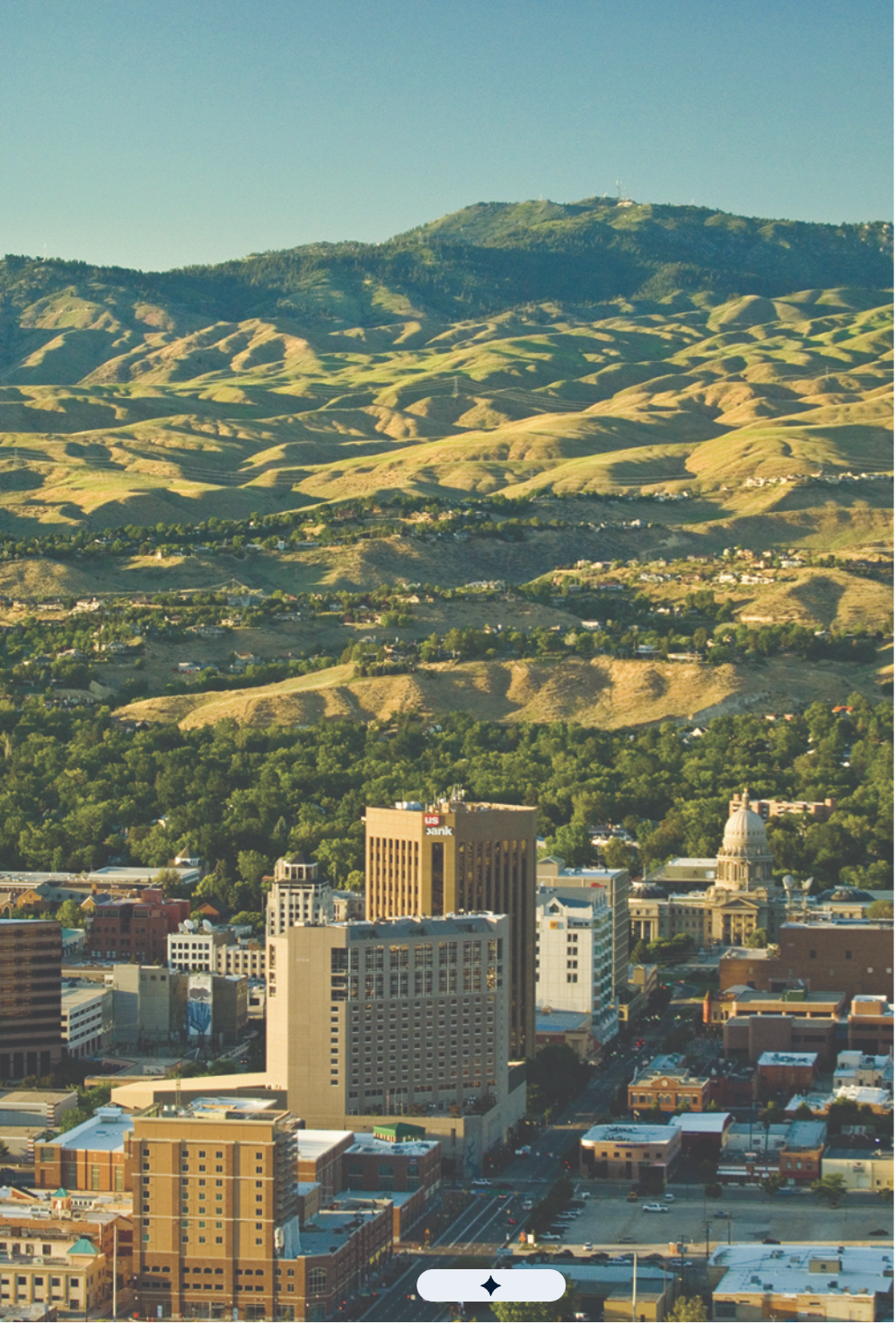
I am writing to you thinking about the beautiful setting in which our city sits. The outdoors has always mattered to Boise, and has similarly mattered to those who live here. As Boise grows and shifts, the conversation always returns to “the outdoors.” We always talk about it as if it’s a park we visit or a backdrop for a photo. However, to many, the outdoors have a deeper meaning, and this deeper meaning should be the mentality of every resident of Boise. Looking at David Harvey’s theories on space, we can see that our “outdoors” are not just a location. They are a social product, and a rhetorical argument we make to ourselves every day about who we are and what we value.
In his work “Space as a Keyword,” David Harvey distinguishes between different ways of understanding the world around us. First, there is absolute space, which is the literal, fixed grid of the city. This is the Boise that those who observe from the outside see, the miles of the Greenbelt, the size of Ann Morrison Park, and the division of our neighborhoods. For a long time, Boise has been treated as absolute space, a resource to be measured and divided. But, we all know that the “outdoors” is actually what Harvey calls relational space. Relational space suggests that a location contains its own history. It is a point where the past and the future collide.
When we stand at the top of Camel’s Back Park, we aren't just standing on a hill of a certain elevation. We are standing in a space that holds the memory of every sunset watched by the native peoples long before a single paved road existed, and those that are still watched by those who call Boise “home” today. For me, this is best experienced when I see the impact that decades of people have made to our environmental spaces. From the signs as you hike up Table Rock, to the murals in downtown Boise dedicated to the beauty of Idaho’s nature, the relationship between Boise and nature has always been memorable. The outdoors in Boise are a vessel for our collective memory. It is the space where we stop being individuals and start being a community.
Beyond the fixed points of our parks and open spaces exists relative space, which Harvey describes through the lens of movement and connection. In Boise, our relative space is defined by the River and the Greenbelt, which are the hubs of environmental movement for our city. In thinking about how the Greenbelt functions rhetorically, it is a persuasive argument for a specific type of urban life. This path that cuts through the heart of Boise is important, as it connects all areas of the city. By this notion, it seems that movement should be a shared, public experience. When we are on the Greenbelt, distance is reduced, and we are forced into proximity with one another. Through the shared ritual of the outdoors, we become one community. We identify with one another because we share the same physical space of the Idaho landscape. The Greenbelt has always held a special place in my heart. From learning how to ride my bike as a young child on the path, to having deep conversations with my mother about my college experiences, so much of what it means to me to live in Boise is defined by experiences on the Greenbelt. Now that I am in college and live farther away from my childhood home, I know that I am still connected to that part of the city, to my family, and to the comfort of childhood because of the Greenbelt. The outdoors is our commonplace. We might disagree on policies or religion, but we start from the common premise that the outdoors of Idaho are sacred.
However, we must be honest about the “commonsense” we have built around this identity. There is a risk that we are turning the outdoors into a commodity. Harvey warns that in a capitalist society, space is often produced to serve the interests of accumulation. As we see luxury properties popping up the river and in the foothills, we have to ask: Is the “outdoors” still a space for everyone, or is it becoming an amenity for a specific class? If we define our community based on our access to recreation, we risk excluding those who don’t have the time or the means to participate in this part of the Boise lifestyle. We often treat our love for the outdoors as common sense. It is an aspect of living in Boise that goes without saying. But whose common sense is it? If the outdoors becomes something we only use for personal fitness or for validation on social media, it ceases to be a community space.
We as the city of Boise must rethink our “outdoors” not as a playground, but as a commons. A commons is a space that is managed by the community for the benefit of all, rooted in trust and protection rather than consumption. When we look at the Boise River, we shouldn't just see a place to float when the weather is warm in the hot summer months. We should see a living entity that requires our protection. When we look at the Foothills, we shouldn't just see undeveloped land or a mountain bike trail. We should see an ecosystem that connects us to Idaho’s history. Boise needs to accept this shift as a rhetorical responsibility. We must use our shared love for this space to build a more inclusive city. If we truly are seen as one community because of this land, then that community bond must extend to how we treat each other on the streets, not just on the trails. The same reverence and respect for our outdoors needs to go beyond nature, and include everyone in Boise. We cannot say that we truly love the environment of Boise and leave out those people that are in it. We cannot value the view of the mountains, while pricing our neighbors out of their homes.
As the city of Boise, we are at a crossroads. We can either continue to produce space that looks like something out of a nature or travel documentary, or we can lean into the relational power of our outdoor spaces. Let us remember that the “outdoors” is the place where we learn to be citizens of our community. By treating our environment as a site of community meaning rather than just recreation, we ensure that as the absolute space of our city grows, our relational space, or the heart of this beautiful city,remains wide open.
Sincerely,
Gia Codina