Congo: Lombi Tree
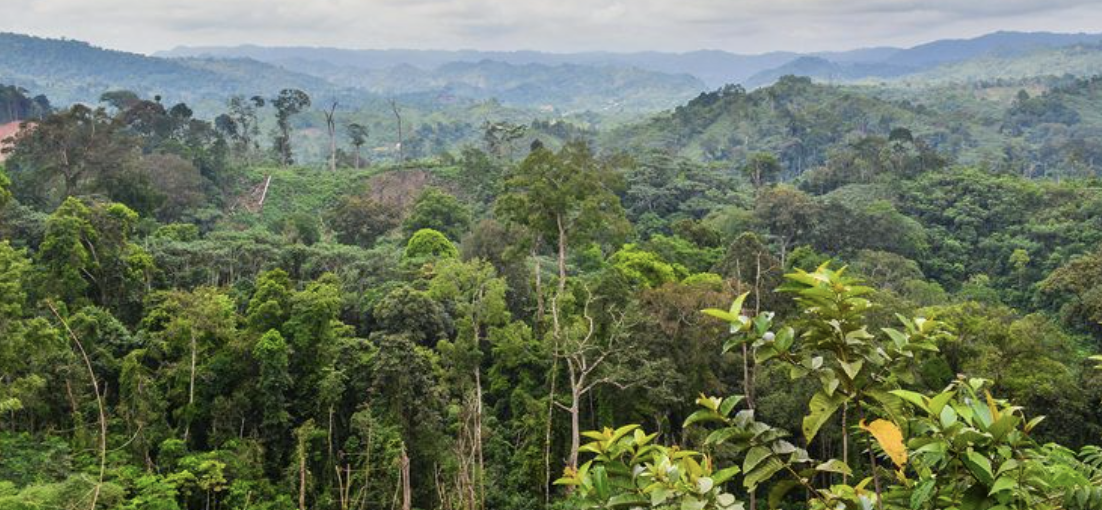
A Lesson on the Congo From D
Ash Miley, Brandon Rasmussen, and Luci Cuellar
We met D, a refugee from the Congo who now lives in Boise, in the lobby at the school he works at. After greeting us in French, he walked us through the hallways of lockers and award cases to a small conference room with a whiteboard on the wall and a printer tucked on a tiny counter beside a long conference table. Perhaps it was the setting, or he knew we were all students ourselves, but as we spoke to him, D’s answers reflected a desire to educate, rather than dwell on his own story.
D started his lesson with a comparison, or lack thereof, for context. “We cannot make a comparison between Africa and the United States,” he said. “The United States is a developed country. On the other hand, Congo is a country very rich in minerals. All cell phones, all computers…these are Congo materials. But the population is poor. Why? Because of politics,” he said. These “politics” D was referring to, is colonialism and the contemporary consequences thereof. Like many countries in Africa, the borders we know today as the Democratic Republic of the Congo, or DRC, were drawn in the late 19th Century by Belgium. In 1885, King Leopold II of Belgium claimed the Congo as his personal property, naming it the “Congo Free State.” For decades, the forces of Belgium drove the Congolese into forced labor, demanding harsh quotas for rubber production. This practice and the many crimes it gave rise to are now known as “Red Rubber” atrocities (Viaene 752).
D spoke about his own familiar connection to these historical abuses. He mentioned that he had grandparents whose arms had been cut off, perhaps due to a refusal to work. Accounts like what D described were, tragically, a well-documented occurrence within the Belgian, Congo. According to historian Roger Anstey, one of such cases was documented by a Congolese man named David Engohahe. The testimony reads: “I myself saw a man at Likange who had had both his hands cut off. Sometimes they cut them at the wrist, sometimes farther up… with a machete...It was sheer cruelty; the State treated us abominably” (Anstey 72). Though most of us in the room don’t speak French, we all felt the gravity in D’s voice as he made chopping gestures at both of his wrists.
However, D’s interest in colonialism primarily centered around language, and how it was used as a tool to subjugate. Here, D circled back around to the question of why he was speaking French. “This is where the introduction of the French language began. They took some Congolese and brought them to Belgium to study. It was to bring civilization to the country. In Congo, there was no school. They did not want to embody themselves in Congolese culture.” Here, D was likely referring to the efforts among Belgian missionaries to create a “civilized” group of “elite” Congolese people to aid their colonization efforts in the country. While Belgian missionaries were taught the various languages of the Congo, people brought from the Congo were taught European languages (Yates 38).
These efforts continued in the Belgian construction of the Congo’s education system at the time. Those few among the Congolese who had been chosen by Belgium were made to speak French, something the Belgian state considered as a sort of paternalistic gift. And, of course, all of this was done in the interest of generating economic power in the region for Belgium. Historian Angina Ndoma writes:
“The language [the Belgians] chose, French, was to be taught only to those Congolese needed in local enterprises. The maintenance of French as the official language in the Congo was a realistic political action predicated on the assumption that Belgian leadership was the prerequisite to rapid economic growth and increased security in the Congo… On the other hand, since most nom-European army officers and state officials in the Congo as well as British American missionaries were speakers of English, the generalized use of French was to be instrumental to stop the spread of the English language” (Ndoma 150-151).
D’s point in bringing in this angle seems to be that language was not just a matter of administration or practicality, but as a deft political tool. “French is not our language — it is a language of colonization. Therefore, it is colonization,” he said.
After the interview, D took to the white board to draw lines along which the Congo is divided, as well as how language divides the Congo the most. With the Congo presenting more than 450 dialects, there are only four official national languages, including Lingala, Swahili, Kikgongo, and French. French is the official language because it is the language that is mostly spoken in the Congo. It is the language which over the whole Congo can be understood by most everyone.
D wanted to teach us that the Congo is more divided by language rather than actual border lines. He was able to show us where he was from in the Congo, and how he saw the Congo divide because of the language that was used.
He spoke Swahili and it was shown on his map that Swahili takes over most of the Southern part of the Congo. The city Kinshasa is considered their capital where Swahili is spoken as well. Towns surrounding the capital show Swahili being one of the most popular languages spoken. Which then changes to where French becomes the more spoken language. This leads to the center of the Congo where Lingala is starting to be the language that is used the most.
D was able to teach us where he thought the borders were based on where he saw language divided. This is part of his experience that’s more than just a map border. As a group we were able to ask questions on what parts he considered home, and how French was integrated into the country. As the writers in the project, our team thought this was such a personal note that D shared with us. Being able to see the rough sketch of the Congo, helped image the kind of borders he saw in everyday life. Which as writers gave us the insight of how D might feel on a daily basis in the United States. As a teacher and refugee, it was greatly appreciated to have a better understanding of his own language. As writers we were interested in the fact that French became the language he uses most, moving to an English-speaking environment.
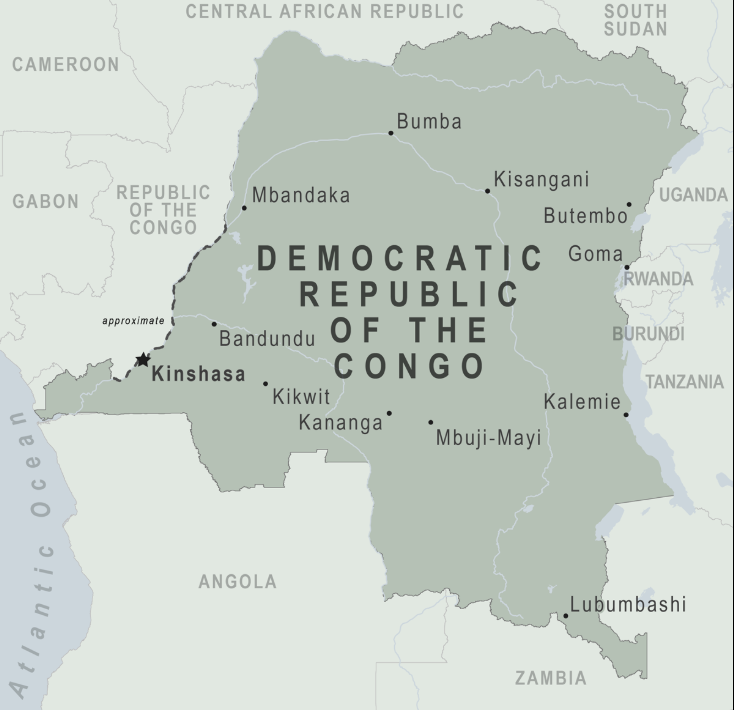
Map of the Democratic Republic of Congo.
D’s tale unfolds against the backdrop of displacement, identity, and resilience, echoing the struggles of countless others forced to flee their homelands. His journey, like that of many refugees, was not a straightforward voyage from Congo to America, but rather a circuitous route through Cameroon, catalyzed by the intervention of international organizations like the United Nations.
The enormity of the refugee crisis looms large, with millions worldwide uprooted by conflict, persecution, and violence. In recent years, increases in violence have only exacerbated the issue. The Congo is currently embroiled in a civil war; 2023 saw over 7 million people affected by fighting between the Congolese government and armed groups in the eastern provinces of North Kivu, South Kivu, and Ituri (UNHCR). As this conflict continues, D’s narrative serves as a poignant reminder of the human toll exacted by these crises. “The Congo is at war and you will find in Uganda, there are Congolese who are in refugee camps. There are also refugees in Tanzania. We have a lot of students who were born in Tanzania, in refugee camps,” D said. D’s story reflects the powerful ways in which language is intricately woven into the fabric of identity and cultural belonging. The imposition of French by Belgian colonizers in Congo eroded indigenous languages, exacerbating communication barriers for refugees like D. His reflections underscore the importance of preserving linguistic diversity and the challenges faced in navigating linguistic landscapes in foreign lands.
Bureaucratic hurdles emerge as yet another obstacle in the refugee journey, as illustrated by D’s accounts of protracted wait times and administrative complexities. “It’s not easy,” D said. “The parents of these children [from Tanzania]—some parents have a total of 30 years in refugee camps.” The slow-paced asylum processes often exacerbate the already precarious situation faced by refugees, underscoring the urgent need for streamlined and responsive policies.
Amidst the adversity, D’s narrative radiates with resilience and fortitude. His unwavering spirit in the face of uncertainty serves as a beacon of hope, underscoring the indomitable human spirit that thrives even in the most adverse conditions. In exploring D’s lesson, we gain a deeper understanding of the refugee experience, transcending statistics and headlines to confront the lived realities of displacement. His story compels us to reexamine our assumptions and prejudices, fostering empathy and solidarity in our collective response to forced migration.
As we reflect on our collaborative endeavor, we extend our heartfelt gratitude to D for his willingness to share his story with us. His courage serves as a testament to the resilience of the human spirit, inspiring us to redouble our efforts in advocating for inclusive and equitable policies for refugees worldwide.
Works Cited
Anstey, Roger. “The Congo Rubber Atrocities -- A Case Study.” African Historical Studies, vol. 4, no. 1, 1971, pp. 59–76. JSTOR
“How Many People Speak French? | by the Numbers.”
Babbel. 2024.
Ndoma, Ungina. “Belgian Politics and Linguistic Policy in Congolese Schools, 1885 1914.” Transafrican Journal of History, vol. 13, 1984, pp. 146–56. JSTOR
Viaene, Vincent. “King Leopold’s Imperialism and the Origins of the Belgian Colonial Party, 1860–1905.” The Journal of Modern History, vol. 80, no. 4, 2008, pp. 741–90. JSTOR
Yates, Barbara A. “Educating Congolese Abroad: An Historical Note on African Elites.” The International Journal of African Historical Studies, vol. 14, no. 1, 1981, pp. 34–64. JSTOR
“Democratic Republic of the Congo Refugee Crisis Explained
USA for UNHCR.” 2018,